

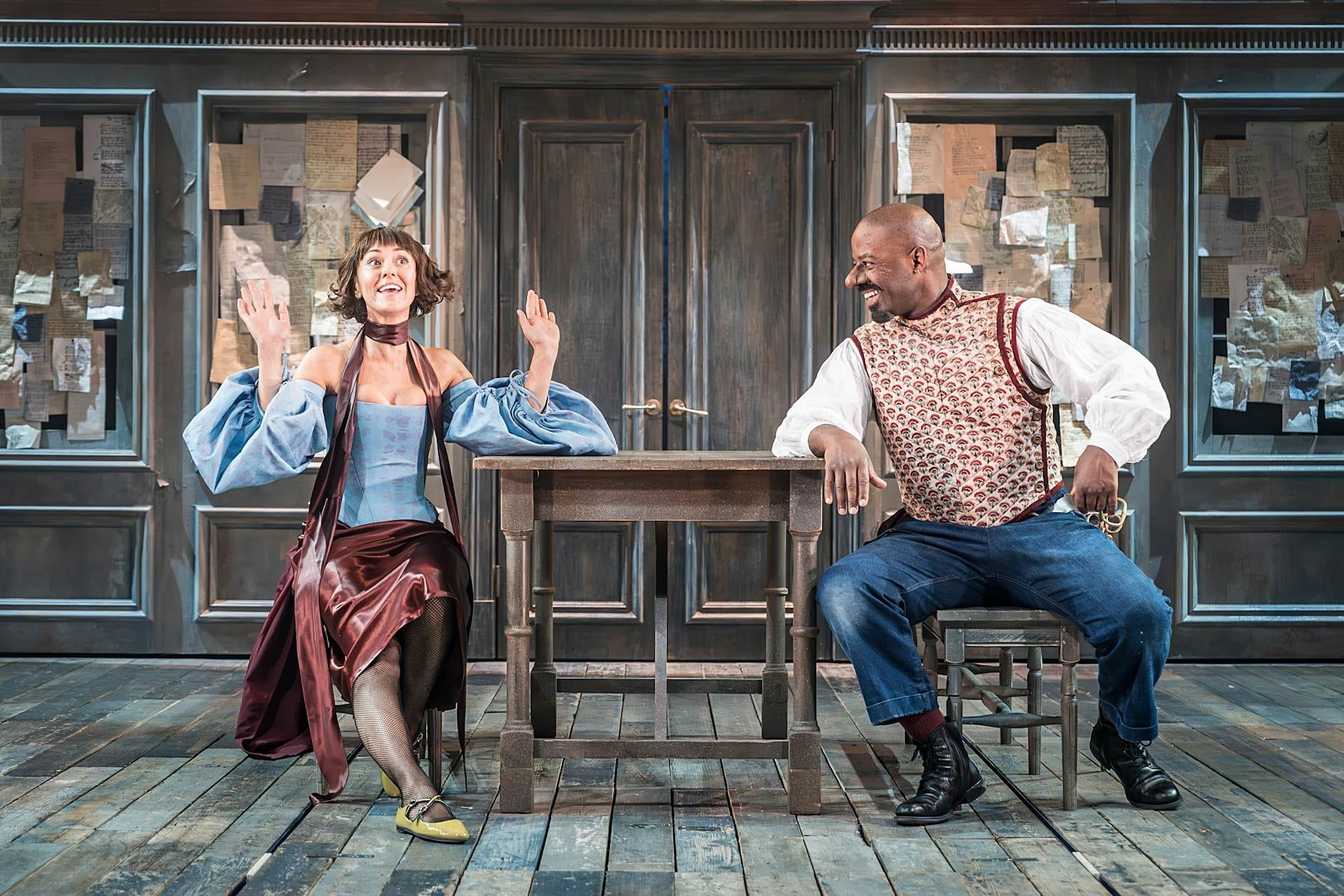
You forget the nose. It is testament to Adrian Lester’s peerless, awards-worthy performance as the eponymous Cyrano de Bergerac — poet, swashbuckler and romantic coward — that, within a few moments of his taking to the stage, you look beyond Cyrano’s undoubtedly considerable schnozz and concentrate instead on this quite exceptional staging of Rostand’s masterly drama about the lengths that we go to deceive ourselves, and others, in the pursuit of love.
It is also credit to Simon Evans’s wonderful RSC production, and to a vibrant, ceaselessly engaging new translation that he and his co-writer, the superbly named Debris Stevenson, have produced that this Cyrano soars afresh and triumphantly.
I have seen other Cyranos in the past — not James McAvoy’s acclaimed, normal-nosed interpretation in Jamie Lloyd’s recent version, but those of Stephen Rea and Antony Sher — and the default interpretation of the character seems to be that of a roaring, charismatic figure, who dominates the stage and leaves little room for the rest of the cast to breathe.
One of the many joys of Evans’s new version is that whilst Lester is a consummate scene-stealer, and wonderfully cast in the main role, he is also able to cede the limelight to the other actors, which he does with the becoming modesty of a truly great thespian.
As anyone who’s ever seen the play — or for that matter, Steve Martin’s Roxanne — will know, the storyline is simplicity itself. Cyrano might be a man of parts, but he is also tongue-tied and bashful in the presence of his recently widowed would-be inamorata Roxanne (usually depicted as his cousin but here reimagined, sensibly enough, as a close friend).
He considers himself hideous because of his large nose, and so has reluctantly settled for the position of friend and confidante, rather than lover. She, meanwhile, has fallen in love with the handsome but intellectually limited Christian, who recruits Cyrano to woo Roxanne by proxy.
This allows him, to his mingled joy and torment, finally to use his words of romance to the same effect as his swordplay. Yet when Roxanne’s aristocratic admirer De Guiche (a hugely effective, nuanced Scott Handy), similarly thwarted in his intentions, orders the men of Gascony to head to war, tragedy duly ensues.
There are aspects of Rostand’s drama that might now be considered Problematic, not least the way that the Christian–Cyrano dynamic could be described as false representation, even catfishing.
And contemporary audiences are likely to have limited sympathy for Cyrano’s inability to declare his feelings for Roxanne, which looks more like emotional retardation than the stoic longing of a heart kept in check.
What makes this new staging of Cyrano so marvellous is that all these considerations and potential pitfalls are considered and answered. In Susannah Fielding’s quite wonderful performance, Roxanne is sparky but also accessible, shrugging off a failed marriage to a decrepit old stick and wishing to fall passionately in love for the first time in her life. As, in their own ways, do Cyrano and Christian.
The triangular relationship between them is teased out with both poignancy and hilarity by Lester, Fielding and Levi Brown, whose Brummie-accented swain is both amusing and charming. But it’s the play’s attention to language that makes it such a delight to hear as well as see.
Cyrano speaks in great ostentatious flurries of verse, dazzling the audience and the other characters early on with a set-piece acrostic after his nose is mocked. Roxanne’s speech is both naturalistic and, in the great final act, full of the hard-won poetry of someone who has realised at the last how, and why, she has been so deceived.
And Christian’s monosyllabic, unadorned dialogue, a stark contrast to the others, has pathos, too: “I have my own feelings, sir,” he says, dolefully, as Cyrano’s verbal fireworks soar and explode around him.
Laughing in the theatre is a great communal experience, but weeping together seems somehow rarer. Rostand’s play comes freighted with great surges of emotion from its third act onwards, as Cyrano finally declares his love for Roxanne on Christian’s behalf whilst literally standing in the shadows, but it is in its climactic moments where it segues from being affecting to devastating.
I saw the play in its first production in Stratford-upon-Avon last year and found the ending moving; I may have shed a discreet tear or two. Here, however, thanks to the power of Lester and Fielding’s performances, everyone around me — including a couple of very well-known theatre critics and A-list actors — were positively bawling their eyes out.
The audience staggered out not so much moved as beside themselves. It was all I could do not to implore passers-by to book there and then, so that they, too, could cry in the stalls.
Perhaps you could accuse the play and its cast and crew of emotional manipulation in the highest degree. Perhaps you might even have a point. But this is West End theatre at its very best. If I see anything better or more moving this year, I’ll be surprised.
Instead, I imagine that, for decades, I will hold up this production of Cyrano de Bergerac as one of the greatest things I have ever seen on stage. Talk about panache.
Thank you for this. The last Cyrano we saw with some film star was so bad we walked out…